Danish dilemma Greenland.
In this article I intend to address the dilemma that we in Europe have received regarding the statements made about Greenland. The statements show the historical ignorance that lies behind the action today based on a hard headed flag HOBO 28 which became Lyndon B Johnson's second broken arrow. How Denmark as a Nato partner had to pay a very high domestic political price.
First a short overview of the HOBO 28 disaster on January 21, 1968.
The USAF Strategic Air Command continued with Operation Chrome Dome and had one of its aircraft monitoring Thule Air Base. This mission was carried out without the knowledge of US civilian authorities, which SAC deemed had no “need to know” specific operational points.
On January 21, 1968, a B-52G Stratofortress, serial number 58-0188, with call sign “HOBO 28” from the 380th Strategic Bomb Wing at Plattsburgh Air Force Base, New York, was assigned the “Hard Head” mission over Thule and nearby Baffin Bay. The bomber crew consisted of five regular crew members.
After a crew member reported the smell of burning rubber, they began searching for a fire. The navigator searched the lower compartment twice before discovering the fire behind a metal box
At 15:22 EST, about six hours into the flight and 140 km south of Thule Air Base, Captain John Haug, the aircraft's commander, declared an emergency. As the situation worsened, the captain realized that he would not be able to land the aircraft and told the crew to prepare to abandon it.
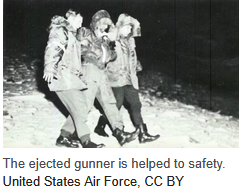
The pilotless aircraft first proceeded north, then turned 180° to the left and crashed on sea ice in North Star Bay at a relatively shallow angle of 20 degrees - about 12.1 km west of Thule Air Base at 15:39 EST.
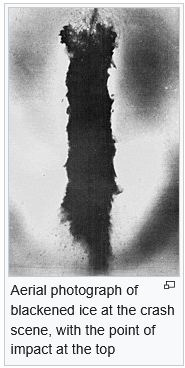
The resulting explosion and fire destroyed many of the components, which were scattered over an area of 1.6 km x 4.8 km. South of the impact area, a 400-foot (120 m) by 2,200-foot (670 m) black spot was visible. This area was heavily contaminated with JP-4 jet fuel and radioactive materials that included plutonium, uranium, americium and tritium. The plane was carrying 4 hydrogen bombs, one of which is still missing. The accident was reported as Broken Arrow
The 'Thulegate' political scandal
Denmark's nuclear-weapon-free zone policy dates back to 1957, when the coalition government decided, ahead of the NATO summit in Paris, not to stockpile nuclear weapons on its soil in peacetime. The presence of the bomber in Greenlandic airspace in 1968 therefore triggered public suspicion and accusations that the policy was being violated. American documents declassified in the 1990s contradicted the Danish government's position on a routine mission and therefore resulted in a political scandal in 1995 that the press dubbed “Thulegate”
The Danish Parliament commissioned a report from the Danish Institute of International Affairs (DUPI) to establish the history of US nuclear overflights of Greenland and the role of Thule Air Base in this regard. When the two-volume work was published on January 17, 1997, it confirmed that the nuclear-armed flights over Greenland were recurrent, but that the US had acted in good faith.
The report accused Danish Prime Minister H.C. Hansen of deliberately introducing ambiguity into the security agreement between Denmark and the US: “he was not asked about, nor did he mention, the official Danish nuclear policy when he met the US ambassador in 1957 to discuss Thule Air Base”. Hansen followed up the discussion with an infamous letter in which he pointed out that the issue of “deliveries of munitions of a special kind” was not raised during the discussion, but that he had nothing further to add. By doing so, the report concluded, he implicitly gave the US the go-ahead to stockpile nuclear weapons at Thule.
Danish workers involved in the clean-up claimed to have suffered long-term health problems as a result of their exposure to radiation. Although they did not work at the Hunziker camp, the Danes worked at the ”Tank Farm” where the contaminated ice was collected, at the port from where the contaminated waste was shipped and they also serviced the vehicles used in the clean-up.
The health of the Danish workers has not been regularly monitored, despite a directive from the European Court of Human Rights to the Danish government to start investigations in 2000, and a resolution from the European Parliament in May 2007 with the same instruction. In 2008, the Association of Former Thule Workers took the case to the ECtHR. The complainants claimed that Denmark's failure to comply with the decisions led to delays in the detection of their diseases, resulting in worsening prognoses.
Danish workers involved in the clean-up claimed to have suffered long-term health problems as a result of their exposure to radiation. Although they did not work at the Hunziker camp, the Danes worked at the ”Tank Farm” where the contaminated ice was collected, at the port from where the contaminated waste was shipped and they also serviced the vehicles used in the clean-up.
The health of the Danish workers has not been regularly monitored, despite a directive from the European Court of Human Rights to the Danish government to start investigations in 2000, and a resolution from the European Parliament in May 2007 with the same instruction. In 2008, the Association of Former Thule Workers took the case to the ECtHR. The complainants claimed that Denmark's failure to comply with the decisions led to delays in the detection of their diseases, resulting in worsening prognoses.

The difficult question
After January 20, 2025, we have seen a shift in the EU that we should be aware of. The issue raised above is how Denmark has faithfully fulfilled its part of a NATO right of use agreement for a US military base in Greenland. By doing so, they have paid a high human and political price.
Now that there is a shift in perspective from right of use agreements to physical ownership, how should we interpret the other right of use agreements we have entered into with the US? This is the common answer Denmark is now seeking within the EU.
We have heard that free trade agreements between the EU and the US may be challenged when one party feels disadvantaged. There is a desire to equalize this with tariffs. Should we interpret this to mean that we in the EU have such internal production competition that the US has fallen behind with its exports? That we in the EU have pushed forward an internal competitive market that causes trade balance problems in the US internal market?
We have now seen that an agreement on the right of use of Greenland is not enough. Should we also interpret this to mean that, in a free trade agreement, the United States has the right of interpretation when it comes to free competition?
As I am a Swedish feminist, I choose to end this story by illustrating this in a song. Stairways to heaven. The future American patriarchal oligarchs are then given a female form. “She is buying a starway to heaven” with the words ”words can have two meanings”

Thank you for listening and reading
Lars-Erik Jonsson